How a Residential Electrician Solves Intermittent Power Issues

Intermittent power problems are among the most frustrating calls a Residential Electrician can take. A dead outlet is straightforward. A tripped breaker that stays tripped usually points somewhere specific. But lights that flicker only at dinner time, a bedroom circuit that works for three days and then cuts out for ten minutes, or a microwave that kills power in one half of the kitchen without tripping anything obvious, those are the jobs that test skill, patience, and method.
They also make homeowners feel a little crazy. The symptom appears, disappears, and then vanishes the moment someone arrives to inspect it. People often apologize before they even explain the problem, because they are sure it will sound vague. In practice, that vagueness is part of the diagnosis. Power problems that come and go usually follow a pattern, even if the pattern is subtle at first.
A good electrician does not chase the symptom blindly. He narrows the field, confirms what the system is doing under load, and works backward from the behavior of the circuit. That process matters because intermittent faults are often tied to heat, vibration, loose terminations, aging breakers, failing devices, or utility-side issues that only show up under certain conditions. Guessing wastes time. Measured troubleshooting finds the cause.
Why intermittent power deserves serious attention
Many intermittent issues start as nuisances and end as safety hazards. A loose connection inside a receptacle, panel, junction box, meter socket, or service connection may work well enough to pass current some of the time. Under heavier load, that same weak point can heat up, expand, arc, and drop voltage. Voltage drop can damage electronics, shorten appliance life, and create enough heat to discolor insulation or device terminals long before a breaker ever trips.
Homeowners often assume that if the breaker does not trip, the problem cannot be dangerous. That is not a safe assumption. Overcurrent protection is designed to respond to too much current, not necessarily to poor connections producing heat at a single point. A failing neutral can be especially deceptive. It may not leave everything dark. Instead, it can create dimming, brightening, buzzing, and erratic behavior across multiple circuits. Those are warning signs, https://elliottepmk622.evergrovio.com/posts/residential-electrician-solutions-for-old-house-wiring not quirks.
I have seen a living room complaint that sounded minor, just “the lamps pulse once in a while,” trace back to a neutral issue affecting half the house. I have also seen the opposite, where a homeowner feared a whole-house defect and the culprit turned out to be a worn backstabbed receptacle feeding three downstream outlets. Experience teaches restraint. The symptom tells you where to start, not where to stop.
What intermittent power actually looks like in the field
Not all intermittent problems present the same way. The exact symptom helps a Residential Electrician sort likely causes before opening a single box. Flickering lights on one switch leg suggest a different path than random resets on a bathroom GFCI. A cluster of dead receptacles that come back when someone plugs in a vacuum often points to a loose feed-through connection. A circuit that fails only during summer afternoons may be reacting to load, ambient heat, or service demand.
The first thing I listen for is scope. Is it one device, one room, one branch circuit, one leg of the service, or the whole house? A homeowner may say “half the house went out,” but that phrase can mean several different things. Sometimes it is literally one phase of a 120/240-volt service dropping out. Sometimes it is a multiwire branch circuit with a shared neutral problem. Sometimes it is simply a string of outlets and lights downstream of a failed connection.
The second thing is timing. Did the issue start after a storm, a renovation, a new appliance, or a panel replacement? Does it happen when the air conditioner starts, when the toaster and coffee maker run together, or when someone uses a hair dryer in the back bathroom? Heat-related electrical faults often become more obvious under sustained load. Mechanical faults may react to vibration, such as a garage door opener running or footsteps in an attic above a loose splice.
The third thing is consistency. A symptom that always appears under the same condition is easier to isolate than one that appears at random. Still, “random” usually means the trigger has not been identified yet. Once someone starts keeping notes, the pattern often sharpens.
The questions an electrician asks before touching anything
A solid diagnosis begins with a conversation, not a screwdriver. The answers shape the test plan and often save an hour of unnecessary dismantling.
- What exactly loses power, and what stays on when it happens?
- Does anything trip, click, buzz, smell hot, or feel warm?
- What appliances or tools are running when the problem appears?
- Has any electrical work, painting, flooring, or cabinetry been done nearby?
- Have the utility lights outside, neighbors, or other homes shown similar issues?
Those questions sound basic, but they reveal whether the likely fault is inside the home, at a device, in the panel, or outside at the service. They also help distinguish a true loss of power from a low-voltage event or equipment problem. Homeowners are often observant in ways they do not realize. A comment like “the hall light gets brighter when the microwave starts” is incredibly useful. So is “if I reset the bathroom GFCI, the garage works again.” That tells me there may be hidden downstream protection someone did not know existed.
Starting at the service, because the house is a system
When intermittent issues affect multiple rooms, especially on opposite sides of the house, the electrician usually starts at the service equipment. The main panel tells a story if you know how to read it. Burn marks, overheated breakers, aluminum branch wiring, doubled neutrals where they should not be, corrosion, loose terminations, and mismatched breaker brands can all turn a clean diagnosis into a deeper correction.
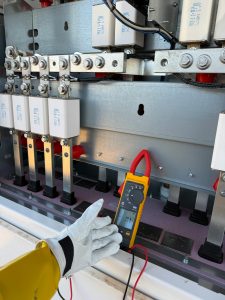
Voltage testing at the panel comes early. The electrician checks line-to-line and line-to-neutral values, and does it under as realistic a load as practical. Stable readings matter, but so does behavior. Voltage that drifts noticeably when loads cycle on can point toward service issues, loose connections, or failing components. If one leg drops and recovers, or if the neutral behaves erratically, the problem may not be confined to a single branch circuit.
This is where intermittent jobs separate beginners from seasoned troubleshooters. A simple meter reading with no load may look perfect. Then a space heater is turned on, or several kitchen appliances run together, and the weak connection reveals itself. Good electricians create conditions that make the fault show up safely. They do not wait passively for luck.
If the symptom suggests a utility-side problem, such as a service drop connection, meter base issue, or supply neutral problem, the electrician documents the readings and coordinates with the utility. That matters because some faults sit outside the homeowner’s wiring but still show up inside the home as flicker, uneven brightness, or partial outages.
Following the branch circuit without making assumptions
If the service looks solid, the next move is usually to identify the affected circuit and trace its path. In many homes, especially older ones, the labels in the panel are only partly correct. “Bedroom plugs” may include a hallway light, an exterior receptacle, and part of a bathroom. Renovations, additions, and decades of small repairs can leave a circuit map that no longer matches reality.
At that stage, an electrician works from known points and tests both upstream and downstream. Receptacles are checked for line voltage, load continuity, polarity, and connection integrity. Switch boxes get opened if lighting is involved. Junction boxes hidden in basements, crawlspaces, attics, or behind access panels often come into play. The goal is not to open every box in the house. The goal is to find the point where power is still stable, then the next point where it is not. The fault lives between those two points more often than not.
One common culprit is the failed feed-through connection at a receptacle. This happens often in houses where wires were pushed into backstab terminals instead of secured under side screws or pressure plates. Over time, heat cycles and normal use can weaken the spring connection. The receptacle itself may still seem to work, but everything downstream loses reliable power. Replacing that device and remaking the connections properly can solve a problem that has annoyed a homeowner for months.
Another frequent issue is a loose wirenut splice in a junction box. These faults can be maddening because they may reconnect when the conductor cools or when someone taps the wall hard enough to shift the wires. I once chased an intermittent dining room outage that occurred only when the homeowner used a treadmill in the room above. The vibration was enough to disturb a marginal splice in a ceiling junction box that had likely been untouched for years.
Load testing reveals what static testing misses
Intermittent electrical faults love to hide from static tests. A meter can show nominal voltage at an outlet with no meaningful load connected, while the same circuit collapses as soon as a coffee maker, vacuum, or portable heater draws current. That is why load testing is so valuable.
A Residential Electrician may use plug-in analyzers, multimeters, clamp meters, or more advanced diagnostic tools, but the principle is simple. Electricity has to be observed doing work. If a circuit has a weak connection, the voltage may sag at that point under load. Heat may rise quickly at a terminal. A breaker may pass current but show signs of internal failure as it warms. In some cases, infrared scanning can help identify abnormal heating, though it is one piece of evidence rather than a magic answer.
The electrician also pays attention to what kind of load triggers the issue. Resistive loads like toasters and space heaters stress a circuit differently than motor loads like refrigerators and sump pumps. Motor startup current can expose a loose connection that smaller electronics will not. Lighting technology matters too. LED lamps make minor voltage fluctuations more visible than older incandescent bulbs did, which is why homeowners often notice flicker now that would have passed unnoticed twenty years ago.
Neutral problems are often stranger than hot conductor problems
When homeowners describe lights getting brighter in one room while dimming in another, I start thinking about a neutral issue very quickly. A loose or failing neutral can produce bizarre behavior because it disrupts voltage balance. Instead of a clean on or off symptom, the house can feel haunted. Electronics reset. Bulbs flash unusually bright, then go dim. One appliance sounds strained while another races.
These problems require caution. On a multiwire branch circuit, an open neutral can create dangerous overvoltage on one side depending on the load balance. On the service side, a compromised neutral can affect large portions of the house. The right response is systematic testing and, if necessary, immediate utility involvement. This is not a “wait and see” category of defect.
In one case, a homeowner complained that her upstairs bathroom vanity bulbs kept burning out. She had replaced them several times and assumed the fixture was cheap. The real issue turned out to be a loose neutral connection in the service equipment that caused voltage swings affecting multiple circuits. The bathroom light was simply the most visible victim.
Breakers can fail in subtle ways
People tend to think of breakers as either on or tripped. Real life is less tidy. Breakers can develop weak internal components, poor bus connections, or heat-related faults that do not present as a clean trip. A failing breaker may intermittently drop power under moderate load, especially after warming up. It may feel hotter than neighboring breakers under similar conditions. It may also make faint noise or show discoloration near the terminal or stab connection.
That does not mean every unexplained outage needs a new breaker. Replacing parts without confirming the cause is lazy troubleshooting. But experienced electricians do keep breaker failure on the table, especially in older panels, environments with moisture or corrosion, or installations where incompatible breaker types have been forced into place over the years.
Panel condition matters here. If one breaker is bad in an otherwise healthy panel, the repair may be simple. If the bus is damaged, the panel has a history of overheating, or the equipment is obsolete, the conversation becomes broader. Sometimes the intermittent fault is the symptom that finally exposes a larger reliability problem.
GFCIs, AFCIs, and nuisance behavior that is not always nuisance
Modern protective devices add another layer to intermittent diagnosis. GFCI and AFCI breakers or receptacles can trip for valid reasons, wiring defects, shared neutral complications, damaged cords, moisture, and occasionally aging devices. The homeowner may describe this as “the power just goes off once in a while,” when what is really happening is a protective device responding to an abnormal condition.
Finding the root cause takes more than swapping the device and hoping for the best. If an AFCI breaker trips intermittently, the electrician has to consider arc-producing loads, loose terminations, damaged insulation, and shared neutral wiring errors. If a GFCI trips only after rain, exterior boxes, landscape wiring, or garage receptacles may be taking on moisture. Context is everything.
I have been called to “fix” a tripping breaker, only to find an outdoor receptacle with insect debris and water intrusion creating exactly the fault the device was meant to catch. Replacing the breaker would have changed nothing. Repairing the enclosure and wiring solved it.
Why documentation often cracks the case
On a difficult intermittent problem, notes are not a luxury. They are part of the diagnostic process. When did it happen, what was running, what weather conditions existed, what reset it, how long did it last, and did lights dim or go fully out? A homeowner with a short log can give an electrician a strong head start.
Some electricians use circuit tracers, thermal images, voltage logs, or direct observation over time. Others ask the homeowner to capture a short video when the issue appears. A panel schedule may be updated during the process if the original labeling is poor. These details help because the hardest intermittent jobs are often solved by correlation rather than one dramatic discovery.
A house is a live environment. People add loads, move furniture, install devices, remodel kitchens, and convert basements. Troubleshooting gets easier when the electrical history is clear. It gets harder when every repair is isolated and undocumented.
What homeowners can do before the electrician arrives
There are a few safe observations that help, and they do not involve opening panels or taking apart outlets. The goal is to gather information, not to perform electrical work.
- Note which lights, outlets, and appliances lose power together.
- Watch whether the issue appears during heavy use, bad weather, or at a certain time of day.
- Check whether a GFCI receptacle has tripped in bathrooms, kitchens, garages, basements, or outside.
- Stop using any outlet, switch, or cord that feels warm, smells burnt, or shows discoloration.
- If multiple rooms brighten and dim unpredictably, call promptly and treat it as urgent.
That last point matters. A sporadic outage in one outlet can often wait for a scheduled service call. Signs of a neutral or service issue deserve much faster attention.
The repair is only half the job
Once the electrician finds the fault, the real work is not just replacing the failed part. It is restoring confidence in the circuit. If a loose connection is discovered at one receptacle, nearby devices and terminations may also deserve inspection, especially if they were installed the same way at the same time. If a breaker has overheated, the mating surface and conductor condition matter too. If a shared neutral circuit was miswired, the fix has to address the configuration, not just the latest symptom.
After the repair, the circuit should be retested under realistic load. Voltage should remain stable. Protective devices should operate normally. Lights should stop flickering for the wrong reasons. If the original fault was rare, the electrician may still explain that intermittent work sometimes requires follow-up if the first failure masked a second one. Honest communication is part of good service. So is knowing when to recommend a larger correction, such as panel work, rewiring, or utility coordination.
Intermittent power issues can feel mysterious from the homeowner side, but they are usually understandable once someone approaches them in the right order. Scope first. Service second. Circuit path third. Load behavior throughout. The process is deliberate because the stakes are real. A strong Residential Electrician brings not just tools, but judgment, patience, and the discipline to prove the problem before declaring it fixed.
That is what separates troubleshooting from guesswork. One changes parts. The other solves the issue.
Paxos Electric Company, LLC
255 NJ-15, Wharton, NJ 07885, United States
+1 973-598-8543
FAQ About Residential Electrician
What does a residential electrician do?
A residential electrician installs, inspects, maintains, and repairs electrical systems in homes. Common services include troubleshooting circuits, replacing panels, adding outlets and lighting, and completing electrical work for renovations.
When should I call an electrician for my home?
Call a licensed electrician if you notice repeated breaker trips, flickering lights, buzzing, burning odors, warm outlets, sparks, or unexplained power loss. Urgent warning signs should be addressed promptly.
Can a residential electrician upgrade an electrical panel?
Yes. A qualified electrician can evaluate the existing service, determine whether an upgrade is appropriate, obtain required permits, and install a panel sized for the home and planned electrical loads.
Do I need an electrician to install an EV charger?
A home EV charger often needs a dedicated circuit and a review of panel capacity. A licensed electrician can confirm the manufacturer requirements and complete the installation according to local electrical codes.